
Catch basin services, Vancouver and Lower Mainland
Table of Contents
Catch basin cleaning cost in Vancouver: what affects price and how to budget accurately
Use this practical estimator to understand typical commercial catch basin cleaning price drivers, what a vendor quote should include, and how to plan a maintenance schedule that prevents flooding, odours, and costly drainage failures.

Serving Vancouver, Burnaby, Surrey, Richmond, and the Lower Mainland
Get a catch basin cleaning quote that is complete, compliant, and easy to approve
If you manage a strata, retail plaza, office, or industrial site, the fastest way to control cost is to confirm access, sediment level, and disposal needs upfront.
- Clear scope: number of basins, sumps, separators, and any pipe jetting
- Safety-first execution for high-traffic sites and restricted areas
- Proper hauling and disposal documentation where required
No forms in this article. Use the quote page or call to schedule.
Key takeaways for budgeting
- Most commercial quotes combine a mobilization charge plus a per-basin cleaning rate, then add disposal and any specialty access needs.
- The biggest price drivers are sediment depth and access: deep sludge, tight parkades, or traffic control typically increase time on site.
- Bundling services reduces total cost when you combine catch basins with vacuum truck service and periodic hydro jetting.
- Maintenance frequency matters: more frequent cleaning usually lowers per-visit time and prevents emergency callouts after heavy rain.
All ranges below are planning numbers for commercial properties in Greater Vancouver. Final pricing depends on site conditions, access, and disposal requirements.
Why catch basin cleaning is a cost issue in Vancouver
Vancouver gets long wet seasons and sudden heavy rain events, which puts pressure on stormwater systems. Catch basins (often called storm drains) are the first collection point for water, sand, leaves, litter, and oils that wash off pavement.
When a basin is plugged or the grate is damaged, you can see pooling, slippery conditions, and water pushing toward entrances, ramps, and underground levels. That is not only an operational headache, it can become a liability issue if slips, vehicle damage, or property flooding occurs.
Why it escalates quickly
If water has nowhere to go, it often finds the lowest point: door thresholds, elevator lobbies, loading bays, or parkade ramps. Emergency response is usually more expensive than routine cleaning, especially if you need immediate pumping, jetting, or traffic control.
What you are actually paying for in a catch basin cleaning visit
“Catch basin cleaning” can mean very different scopes. A clean quote should tell you exactly what is included so you can compare vendors fairly.
Typical scope elements
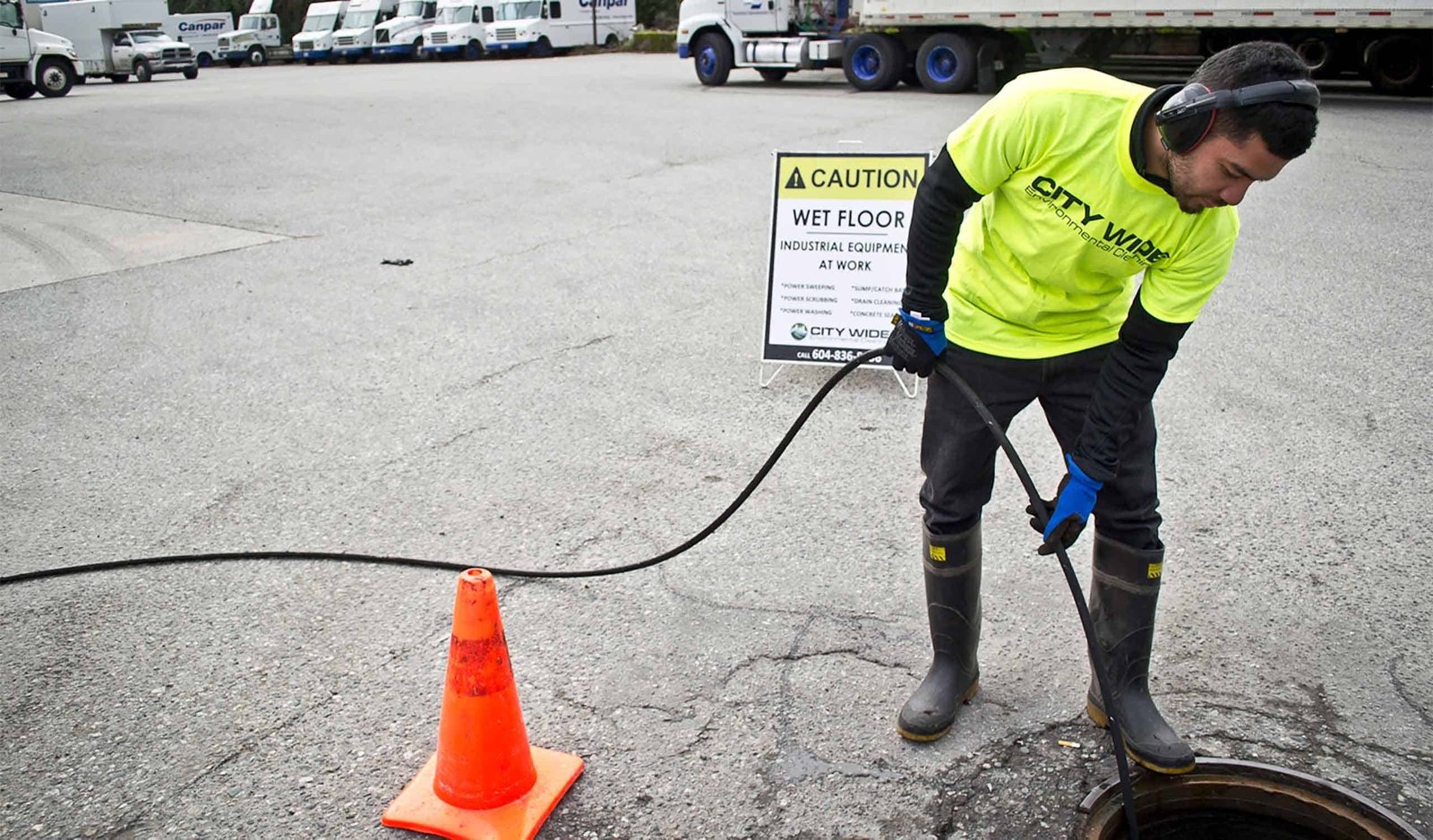
- Site setup and access management: arrival, staging, safety cones, and working around live traffic.
- Grate lift and inspection: checking grate condition, frame stability, and obvious blockages.
- Removal of debris and sediment: vacuum extraction of leaves, gravel, and sludge.
- Water rinse as needed: to clear remaining fines and improve flow.
- Documentation: notes, before/after condition reporting, and disposal documentation when required.
Common add-ons that change price
- Hydro jetting of connected lines to clear buildup and restore flow.
- Sump, separator, or vault cleaning if your system includes oil-water separation or deeper chambers.
- Traffic control for active drive lanes, loading zones, or municipal frontage areas.
- Restricted access equipment for tight parkades or height-limited areas.
- After-hours scheduling to avoid tenant disruption at retail, hospital, or hotel sites.
A practical 3-step estimator for catch basin cleaning cost
Most commercial properties can budget accurately by splitting cost into three parts: mobilization, per-structure cleaning, and disposal or specialty requirements. This mirrors how many vendors structure quotes for predictable planning.
Count and locate
Record how many catch basins you have, and whether there are sumps, separators, or vaults tied to the system.
Rate the condition
Light, moderate, or heavy sediment. Heavy sludge takes longer, may need rinse-down, and can increase disposal fees.
Add access and disposal
Access constraints, traffic control, and disposal documentation can be the difference between a simple service and a complex one.
| Scenario (commercial) | What is usually included | Typical planning range (Vancouver area) | What pushes it higher |
|---|---|---|---|
| 1 to 4 catch basins, light sediment | Mobilization, grate lift, vacuum removal, quick rinse, basic notes | $450 to $950 per visit | After-hours work, difficult staging, multiple levels |
| 5 to 12 catch basins, mixed conditions | Batch cleaning with truck, basic reporting, minor hand removal where needed | $900 to $2,200 per visit | Heavy sludge in several basins, active traffic lanes |
| Parkade system with sumps or separators | Catch basins plus deeper chambers, additional rinsing, more hauling capacity | $1,600 to $4,500+ per visit | Confined-area protocols, restricted height, thick sludge, oil contamination |
| Catch basins plus hydro jetting | Vacuum cleaning plus jetting of connected lines (targeted) | $1,400 to $5,500+ per visit | Long runs, multiple blockage points, extensive jetting time |
| Emergency response after flooding | Priority dispatch, rapid clearing, potential pumping and additional cleanup | $1,800 to $7,500+ depending on scope | After-hours, multiple crews, added cleanup, access limits |
These planning ranges are intended for budgeting, not as a binding quote. The biggest variable is the time required per structure, which depends heavily on sediment depth, access, and whether the line downstream needs jetting.

Need a fast budget number for approvals?
Send the basin count and access notes, get a quote you can compare
A comparable quote has three parts: mobilization, per-structure cleaning, and disposal or jetting as needed. If a quote is missing one of those, it is hard to approve with confidence.
Tip: If your basins are in a parkade, include clearance height and the level (P1, P2, etc.).
What affects catch basin cleaning price the most
If you have ever received two very different numbers for the same property, it is usually because the vendors assumed different scope and risk. Use the factors below to sanity-check any estimate.
| Cost driver | What it means on site | How it impacts price | How to control it |
|---|---|---|---|
| Sediment depth | Light debris vs thick sludge and compacted material | More vacuum time, more rinse cycles, more hauling | Increase frequency until basins stay in “light to moderate” condition |
| Access and staging | Truck proximity, hose distance, height restrictions | Longer setup and hose runs increase labor time | Share access routes, reserve stalls, confirm clearance |
| Traffic control needs | Live vehicle and pedestrian movement around work zone | Extra time and sometimes additional personnel | Schedule early morning, coordinate loading areas, use partial closures |
| System complexity | Presence of sumps, separators, vaults, or multiple inlet types | More steps, more documentation, higher disposal volume | Map the system and bundle services in one visit |
| Jetting requirement | Downstream pipe buildup reduces flow even if basin looks clean | Jetting adds equipment time and water management | Plan periodic hydro jetting instead of emergency callouts |
| Contaminants | Oil, greasy sediment, or industrial residue | May require special handling and disposal documentation | Improve spill response and sweep more frequently |
| After-hours or tight windows | Retail, hotels, hospitals, and high-traffic sites | Premium scheduling, more crew coordination | Book recurring windows well in advance |
What a “good” quote looks like (so you can compare vendors)
A strong quote is not only about the total. It is about clarity. You want a scope that prevents surprise add-ons and makes it easy to approve internally.
Minimum quote checklist
- Count and locations of catch basins, plus any sumps, separators, or vaults.
- Method: vacuum extraction, rinse, and whether vac truck service is the primary approach.
- Jetting scope if included: targeted lines or full system, and what “included minutes” means.
- Access assumptions: where the truck stages, any clearance constraints, and any required closures.
- Disposal and documentation: where material is hauled, and what paperwork is provided.
- Reporting: what you get for records, including notes, photos when appropriate, and recommendations.
Red flags that usually lead to change orders
- “Catch basin cleaning” with no mention of sediment depth or disposal volume.
- Unclear language like “as required” for jetting, without limits or conditions.
- No access plan for parkades or tight service corridors.
- No mention of safety controls around traffic or pedestrians.
How often should commercial catch basins be cleaned in Vancouver?
Frequency depends on what your property collects. Retail lots often capture a lot of litter. Strata buildings may collect sand and organics from nearby landscaping. Industrial sites may have heavier sediment and residue.
Simple frequency guide (planning)
- Quarterly if you have heavy leaf fall, frequent ponding, or repeated plugging after storms.
- Biannual for many strata, office, and mixed-use sites that want predictable maintenance and fewer surprises.
- Annual for low-debris properties with good sweeping programs and stable drainage performance.
- After major construction or resurfacing to remove sediment that washes into inlets.
If you are seeing ponding, odours, or slow drainage, do not wait for the next scheduled visit. Those are signs that the basin or the connected line is already compromised.
Common concerns property managers ask about catch basin cleaning
“Can we just do it when it floods?”
You can, but it is usually the most expensive way to manage it. Emergency response tends to include premium scheduling, more disruption, and sometimes secondary cleanup if water has already reached doors, ramps, or indoor areas.
“Will cleaning disrupt tenants and traffic?”
It depends on access. For most commercial lots, disruption is minimal if the vendor stages correctly and works one zone at a time. For parkades and loading bays, after-hours scheduling often makes approvals easier.
“Do we need hydro jetting every time?”
Not always. If your problem is surface debris and sediment in the basin, vacuum cleaning often solves it. Jetting becomes valuable when the downstream line is restricted, you have repeated backups, or you are bundling preventative maintenance with a full drainage service.
“Is this a safety issue?”
It can be. Some drainage structures and vaults can be treated as confined spaces depending on configuration and entry requirements. A professional vendor should plan around safety protocols, traffic control, and the specific hazards of the site.
When to bundle catch basin cleaning with other services
Bundling is often the best way to lower total cost while improving outcomes. The reason is simple: mobilization and staging are already paid for, so adding a related task is usually cheaper than a separate callout.
High-value bundles
- Catch basins + vacuum truck service for comprehensive debris removal across the system: vac truck services.
- Catch basins + hydro jetting for improved flow and fewer backups: hydro jet drain cleaning.
- Catch basins + parkade cleaning if your drainage issues are tied to sediment and residue across parkade surfaces: parkade cleaning.
- Catch basins + sweeping to reduce the volume entering the system between cleanings: power sweeping.
Facilities that benefit most from planned catch basin maintenance
Catch basin cleaning is not only for parking lots. Any paved, drained surface that collects runoff benefits from routine maintenance.
- Strata condos and apartment buildings
- Retail plazas and grocery sites
- Office buildings
- Warehouses and shipping facilities
- Hotels and hospitality
- Hospitals and clinics
- Municipal facilities and public buildings
Local service coverage in the Lower Mainland
City Wide Environmental Cleaning serves commercial and industrial properties across Vancouver and the surrounding area, including Burnaby, New Westminster, Surrey, White Rock, Langley, Coquitlam, Richmond, Delta, Maple Ridge, and Abbotsford. If you need a location-specific service overview, see catch basin services in Vancouver.
FAQ: catch basin cleaning cost and planning
How much does it cost to clean a catch basin in Vancouver?
For commercial sites, planning ranges commonly fall between a few hundred dollars for small, light-sediment visits and several thousand for larger systems with heavy sludge, restricted access, or added jetting. The most accurate approach is to confirm basin count, condition, and access constraints, then request a scoped quote.
What is usually included in a catch basin cleaning quote?
Most quotes include mobilization, grate lift, vacuum removal of debris and sediment, a rinse as needed, and basic documentation. Add-ons may include hydro jetting, sump or separator cleaning, traffic control, or specialized disposal documentation.
Why do prices vary so much between vendors?
Price differences usually come from scope assumptions. One vendor may assume light sediment and easy staging, while another assumes heavy sludge, longer hose runs, traffic control, or disposal paperwork. A good quote lists assumptions clearly.
How do I know if we also need hydro jetting?
If basins are clean but drainage is still slow, or you get repeated backups after storms, the downstream pipe may be restricted. In those cases, bundling basin cleaning with targeted hydro jetting often improves flow and reduces future emergency calls.
Can our maintenance team clean catch basins in-house?
Basic debris removal at the grate can be handled in-house, but full sediment extraction and hauling typically requires vacuum equipment and safe handling practices. If any entry, vault work, or high-risk conditions are involved, use a qualified vendor.
How often should strata and apartment buildings schedule cleaning?
Many strata properties land in a biannual schedule, with seasonal adjustment if leaf fall or construction increases sediment. The goal is to prevent plugging and keep each visit in a lighter condition band, which helps control cost.
Does catch basin cleaning help with odours?
Yes, odours can come from organic buildup, stagnant water, and residue. Removing sediment and restoring flow often reduces odour issues, especially when the system is serviced before peak wet-season conditions.
What information should I send to get an accurate quote quickly?
Send the basin count, any known sump or separator locations, access notes (truck staging area, parkade clearance, levels), and whether you have seen backups or flooding. If you have photos of a couple basins, include one showing sediment depth.
Prevent flooding, reduce liability, protect your drainage system
Ready to put catch basin cleaning on a predictable schedule?
If you want fewer emergency calls and easier approvals, the best next step is a scoped quote that includes basin count, access, and any jetting needs.
Serving Vancouver, Burnaby, New Westminster, Surrey, White Rock, Langley, Coquitlam, Richmond, Delta, Maple Ridge, and Abbotsford.
Prepared by City Wide Environmental Cleaning. Reviewed for operational accuracy by field supervisors familiar with commercial drainage maintenance in the Lower Mainland.